


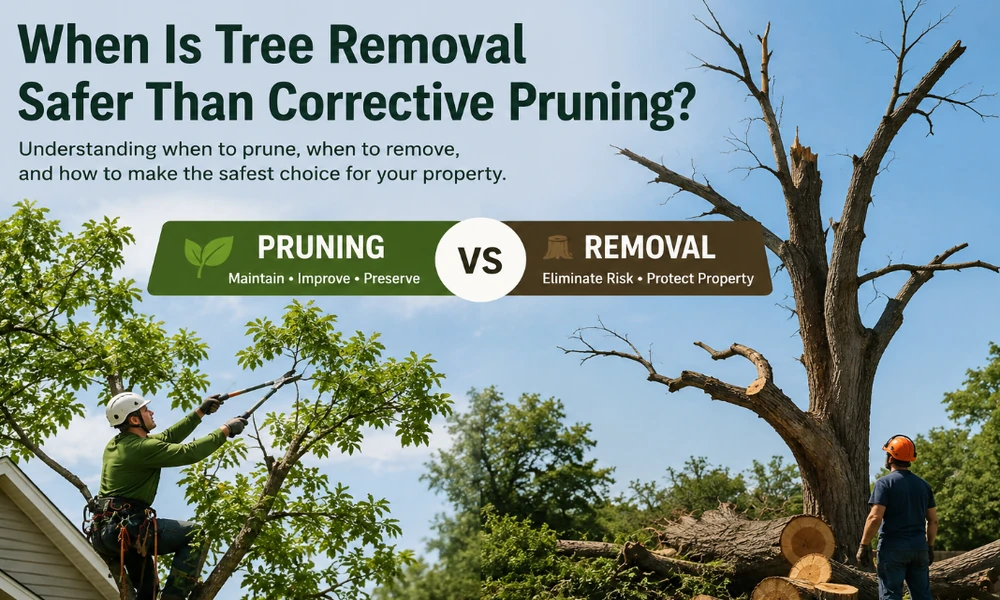
Trees are valuable parts of a property. They provide shade, improve the landscape, and can make an outdoor space feel more comfortable. Because of that, many homeowners prefer to save a tree whenever possible.
Corrective pruning is often a good option when a tree has damaged, weak, or poorly growing branches. But pruning is not always enough.
Sometimes the safer choice is full tree removal.
Understanding tree removal vs pruning can help property owners decide when a tree can still be managed and when keeping it may create too much risk.
When Does Corrective Pruning Make Sense?
Corrective pruning focuses on removing specific branches while keeping the main tree in place.
It may help when a tree has a few dead branches, crossing limbs, weak growth, or storm-damaged sections. Removing these areas can improve the structure of the tree and reduce the chance of branches falling later.
Pruning can also improve clearance around roofs, driveways, sidewalks, or utility lines.
If the trunk is strong, the root system is stable, and most of the canopy is healthy, pruning may be enough to manage the problem.
In many cases, this is the better choice because it allows the tree to remain part of the property.
When Is Tree Removal Safer?
Tree removal may be safer when the problem affects the entire tree instead of just a few branches.
A large crack in the main trunk is one warning sign. Deep cavities, major decay, or large areas of missing wood can also weaken the tree.
A tree with serious structural damage may still have green leaves, which can make it look healthy from a distance. But appearance does not always show what is happening inside the trunk.
If the main structure can no longer support the weight of the tree, pruning a few branches may not solve the larger problem.
What Does a Dangerous Lean Look Like?
Some trees naturally grow at an angle, so a leaning tree is not always unsafe.
The bigger concern is a tree that has recently started leaning or appears to be leaning more over time.
Look around the base.
Raised soil, exposed roots, cracks in the ground, or roots pulling away from the soil may suggest that the tree is becoming unstable. This can happen after storms, flooding, erosion, construction, or root damage.
In this situation, trimming branches might reduce some weight, but it does not repair the root system.
Removal may be safer if the tree is at risk of falling.
Can Severe Decay Be Fixed With Pruning?
Small areas of dead or damaged wood may often be removed through pruning.
Widespread decay is different.
Fungal growth, large cavities, soft wood, hollow sections, peeling bark, or repeated branch failure can all point to deeper problems.
If decay has reached the main trunk or major structural branches, the tree may no longer be strong enough to remain safely standing.
This is especially important when the tree is close to a home, road, parking area, or other place where people regularly spend time.
How Does Root Damage Affect the Decision?
Roots are easy to forget because most of them are underground.
Still, they are one of the most important parts of tree stability.
Construction, digging, trenching, soil compaction, disease, or erosion can damage the root system. A tree may continue looking healthy above ground for some time even after serious root damage has occurred.
If enough structural roots are damaged, pruning the canopy may not solve the problem.
A weak root system can increase the risk of the entire tree falling during high winds or heavy rain.
Does the Tree’s Location Matter?
Yes. Location plays a major role when comparing tree removal vs pruning.
A damaged tree growing in an open area may present less immediate danger. The same tree next to a house, playground, driveway, power line, or busy sidewalk may create a much greater risk.
The possible consequences of failure matter.
Sometimes a tree might survive with extensive pruning, but leaving it standing may still be an unnecessary risk because of what is nearby.
Can Too Much Pruning Make Things Worse?
Pruning is useful, but removing too much of a tree at one time can create new problems.
Trees need leaves to produce energy. Heavy pruning can stress the tree, reduce growth, and sometimes encourage weak new branches.
Large pruning cuts also create wounds that take time to close.
If making the tree reasonably safe would require removing a large part of its canopy, full removal may make more sense than trying to keep a severely weakened tree alive.
Final Thoughts
The choice between tree removal vs pruning depends on the condition of the entire tree.
Corrective pruning often works well when damage is limited and the trunk, roots, and main structure remain strong. Tree removal may be safer when there is severe decay, major root damage, structural cracking, instability, or a high risk of falling.
Saving a tree is often worth considering. But safety comes first.
A careful evaluation of the tree’s health, structure, location, and surrounding property can help determine whether pruning is enough or whether removal is the safer long-term decision.
This post was written by a professional arborist at Tree Removal Largo FL. Robert Miller is the owner of Arbor Wise Professional Tree Care, a locally owned and operated tree service company that offers superb lawn care by the most experienced Arborists. Arborwise Tree Services is a tree removal company that offers stump removal, tree pruning, stump grinding, fertilization, and tree restoration. We have an extraordinary lawn care industry notoriety covering the Pinellas county area.
